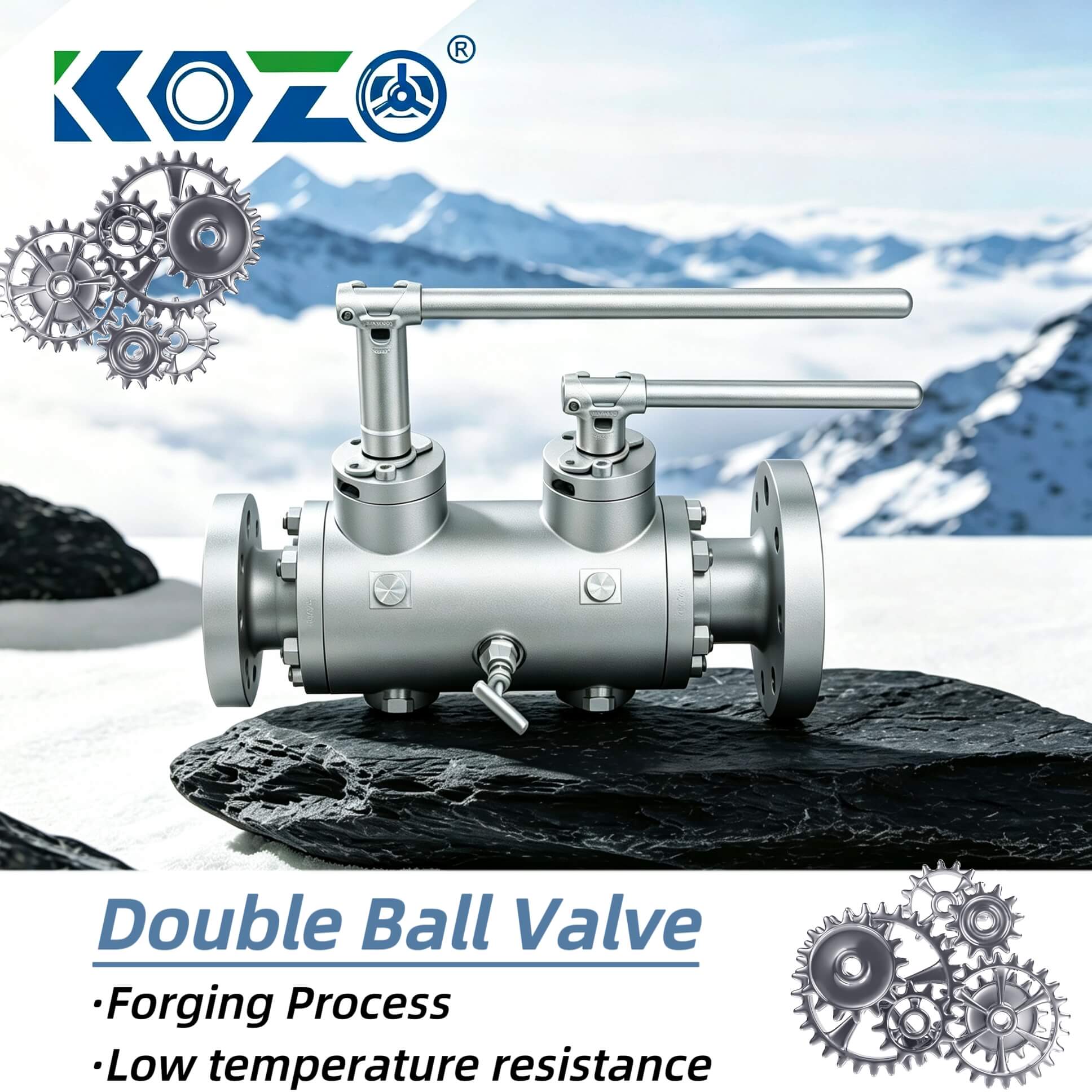
Low-temperature double ball valve
Applicable Standards:
Ball Valve Design Standards: API 6D, BS 5351, ASME B16.34
Face-to-Face Dimensions: ASME B16.10, API 6D
Flange Standards: ASME B16.5 / ASME B16.47
Butt-Weld End Standards: ASME B16.25
Fire Safe Testing: API 607, API 6A
Inspection and Testing Standards: API 598, API 6D
Design Features:
Structure: 2-piece or 3-piece body design
High-integrity sealing structure with low operating torque
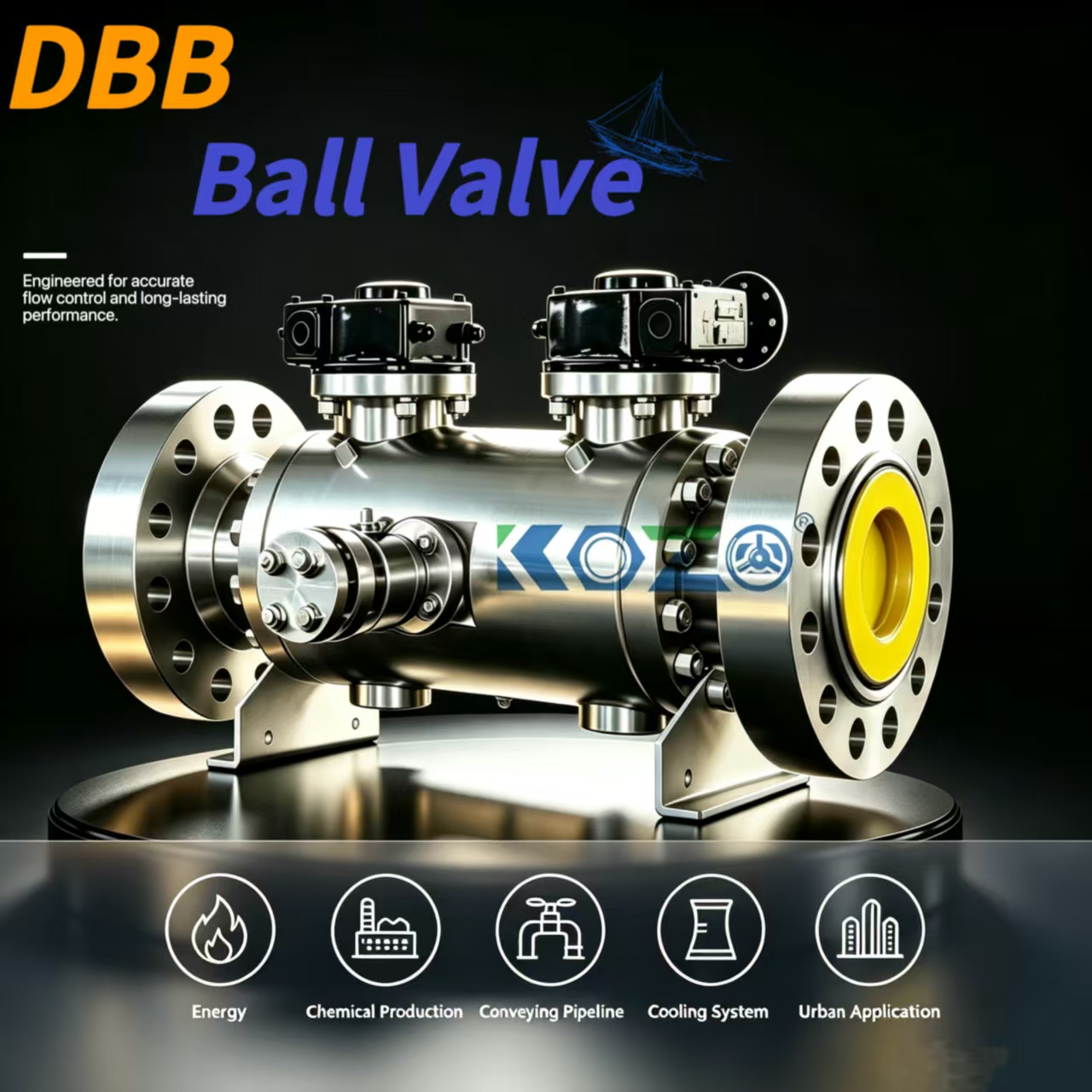
Double Block and Bleed (DBB) function
Cavity self-relief mechanism
Fire-safe design
Anti-blowout stem
Anti-static design
Locking device (for lever-operated valves)
ISO 5211 actuator mounting pad
Emergency sealant injection function
Application Fields:
Oil & Gas: Wellhead equipment, pipeline pigging stations, storage tank inlets/outlets, oil and natural gas transmission
Chemical Processing: Reactor isolation, toxic media transport, high-pressure process lines
Energy & Power: Power generation, boiler fuel shut-off, main steam line isolation
Special Applications: Subsea pipelines, LNG facilities, strategic reserve depots
Brand: KOZO
Valve Materials: Carbon steel, high-temperature Cr-Mo steel, stainless steel, duplex stainless steel, Monel, aluminum bronze, special alloy steels, etc.
Valve Type: KOZO Ball Valve
Valve Testing: 100% tested prior to delivery
Warranty: 18 months after shipment or 12 months after installation (whichever occurs first)
Valve Structure: Trunnion-mounted ball valve
Size Range: 1/2" to 48"
Pressure Class: ASME Class 150, 300, 600, 900, 1500, 2500
Lead Time: 15 – 30 days
Samples: Samples available upon request from KOZO Valves
Valve Color: Customized according to customer requirements
Packaging: Plywood crates
Minimum Order Quantity (MOQ): 1 set
Country of Origin: Zhejiang, China (Mainland)
Shipping Port: Shanghai or Ningbo
Payment Terms: L/C, D/P, T/T, Western Union
Low-temperature double ball valve - Dual isolation and online verification solution for cryogenic working conditions
Design concept
The two independent ear shaft fixed ball sealing pairs and the middle chamber discharge chamber are integrated into an integral valve body, specially designed for cryogenic media ranging from -46°C to -196°C. Each sphere is rigidly supported by an ear shaft, and the medium thrust is introduced into the valve body, making the sealing load controllable. The entire structure is preset with cryogenic shrinkage compensation, and the extended valve cover keeps the stuffing box away from the cold source. Core logic: Working seals and safety seals coexist independently. The middle cavity can be fully discharged through the diameter. Seal failure changes from latent to explicit. A compact device is used to achieve dual isolation for online verification of cryogenic pipelines, meeting the safety confirmation requirements of zero-energy isolation.
Performance advantage
· Double isolation and discharge: Two independent spherical sealing pairs, with a full-size discharge port in the middle cavity, can verify the sealing integrity of the upstream and downstream one by one online, meeting the API 6D DBB definition and zero-energy isolation verification under cryogenic conditions.
· Bidirectional zero leakage: Each ball is of a fixed ball structure. The medium of the downstream valve seat is self-tightened, and the spring of the upstream valve seat is pre-tightened. It is bidirectional airtight level off from low pressure to full pressure, meeting the API 598 zero bubble acceptance.
· Dual self-relief of cavity pressure: The valve seat upstream of each ball can automatically relieve pressure. Abnormal pressure rise caused by reheating and vaporization in the middle cavity and each cavity can be released to the upstream side without the need for an external safety valve, ensuring the safety of the sealed cavity.
· Low operating torque: The ear bearing bears all the medium thrust, with a torque of only 1/3 to 1/5 of that of the floating ball of the same specification. It can be matched with smallger-sized cryogenic actuators, reducing the set cost.
· Online verifiability: The health status of each sealing pair can be diagnosed without disassembling the pipeline through the medium outflow state of the middle cavity discharge port, supporting predictive maintenance.
· Compact structure: One unit replaces the traditional double-valve plus discharge manifold, reducing the surface-to-surface size by 40% to 50%. It is particularly suitable for space-constrained applications such as LNG loading and unloading arms, tank truck loading and unloading stations, and Marine skids.
Safety performance
· Fireproof structure: Each spherical sealing pair contains a primary non-metallic seal and a secondary metallic seal, and has passed the API 607/6FA certification. In case of fire, both isolation lines can maintain effective shut-off.
· Anti-blowout valve stem: All valve stems adopt an inverted sealing step design, meeting API 608 standards. When the cover is loosened, the valve stem will not be blown out by the medium pressure.
· Extended valve cover insulation: The neck of the valve cover extends beyond the insulation layer to ensure that the temperature of the stuffing box is above the freezing point. Combined with the live load disc spring for continuous compensation, it prevents freezing cracking and dissipation.
· Anti-static conduction: The resistance between each ball, valve stem and valve body is ≤10Ω, promptly conducting away the static electricity generated by the flow of cryogenic medium.
· Dual-chamber overpressure protection: Built-in self-relief valve seat + selectable external discharge pipeline for dual protection to prevent pressure build-up in the chamber.
· Low-temperature actuator adaptation: Low operating torque is compatible with single-acting pneumatic spring return actuators. They automatically close when gas or power is cut off, meeting the ESD emergency shut-off requirements.
Applicable working conditions
· Medium: LNG, liquid oxygen/liquid nitrogen/liquid argon, liquid ethylene/propylene, liquid ammonia, liquefied petroleum gas and other cryogenic hydrocarbons
· Scenarios: Inlet and outlet of LNG receiving station storage tanks, tank truck loading and unloading stations, air separation units, ethylene storage and transportation, Marine LNG supply systems, and stations in extremely cold regions
· Drive: Manual, worm gear, pneumatic (spring return), electric (special for cryogenic)