Gas-liquid linkage fully welded ball valve
Applicable Standards:
Ball Valve Design Standards: API 6D, BS 5351, ASME B16.34
Face-to-Face Dimensions: ASME B16.10, API 6D
Flange Standards: ASME B16.5 / ASME B16.47
Butt-Weld End Standards: ASME B16.25
Fire Safe Testing: API 607, API 6A
Inspection and Testing Standards: API 598, API 6D
Design Features:
Structure: 2-piece or 3-piece body design
High-integrity sealing structure with low operating torque
Double Block and Bleed (DBB) function
Cavity self-relief mechanism
Fire-safe design
Anti-blowout stem
Anti-static design
Locking device (for lever-operated valves)
ISO 5211 actuator mounting pad
Emergency sealant injection function
Application Fields:
Oil & Gas: Wellhead equipment, pipeline pigging stations, storage tank inlets/outlets, oil and natural gas transmission
Chemical Processing: Reactor isolation, toxic media transport, high-pressure process lines
Energy & Power: Power generation, boiler fuel shut-off, main steam line isolation
Special Applications: Subsea pipelines, LNG facilities, strategic reserve depots
Brand: KOZO
Valve Materials: Carbon steel, high-temperature Cr-Mo steel, stainless steel, duplex stainless steel, Monel, aluminum bronze, special alloy steels, etc.
Valve Type: KOZO Ball Valve
Valve Testing: 100% tested prior to delivery
Warranty: 18 months after shipment or 12 months after installation (whichever occurs first)
Valve Structure: Trunnion-mounted ball valve
Size Range: 1/2" to 48"
Pressure Class: ASME Class 150, 300, 600, 900, 1500, 2500
Lead Time: 15 – 30 days
Samples: Samples available upon request from KOZO Valves
Valve Color: Customized according to customer requirements
Packaging: Plywood crates
Minimum Order Quantity (MOQ): 1 set
Country of Origin: Zhejiang, China (Mainland)
Shipping Port: Shanghai or Ningbo
Payment Terms: L/C, D/P, T/T, Western Union
Gas-liquid linkage fully welded ball valve
Design concept
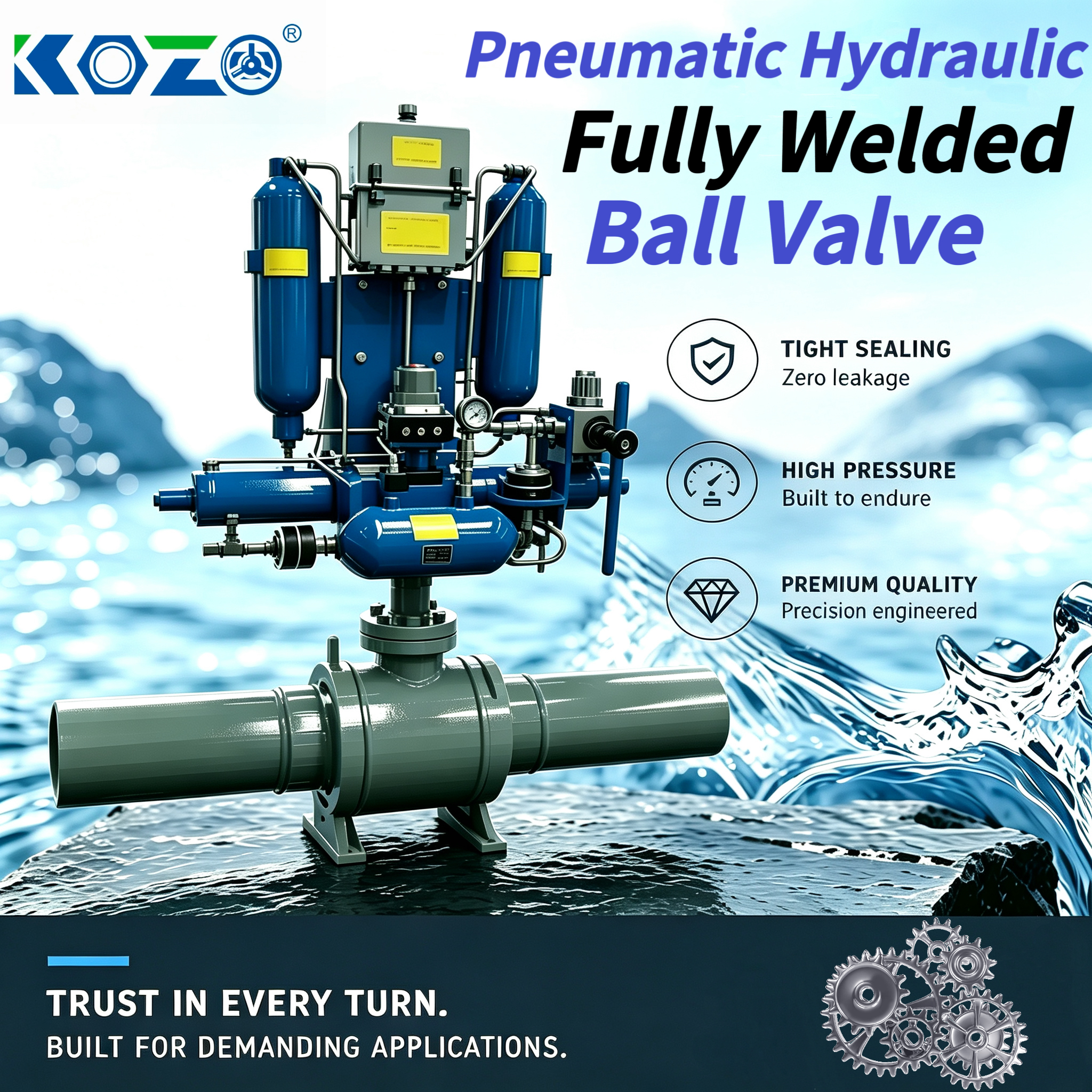
To meet the full life cycle service requirements of buried and above-ground high-pressure pipelines, we integrate the forged steel fully welded valve body with the highly reliable pneumic-hydraulic linkage actuator into one unit, and complete the joint test before leaving the factory. The fully welded structure effectively avoids the valve body flange and potential leakage channels. The gas-hydraulic linkage actuator stores energy with high-pressure gas and can provide high thrust without external power supply in emergency situations, achieving fail-safe operation. From the fixed ball structure to the double-sealed valve stem, the design pursues low maintenance requirements, high availability and intrinsic safety.
Performance advantage
Double shut-off and relief function - In the fully closed position of the valve, both valve seats are independently sealed, allowing the valve cavity to be vented under full pressure difference to achieve verifiable isolation.
Self-relief valve seat and double-piston effect - both the upstream and downstream valve seats can bear pressure in both directions. When the valve cavity is abnormally overpressurized, the valve seat automatically releases pressure to the pipeline side to prevent the valve body from being overloaded. Under normal operating conditions, the double-piston effect ensures a tight seal with no visible leakage even when there is a low pressure difference.
Full bore, low pressure drop - The inner diameter of the spherical channel is consistent with that of the pipe, allowing it to pass through the pigging device, with negligible pressure drop, meeting the demand for large flow transportation.
Long-lasting sealing - Metal-to-metal contact supplemented by fluoropolymer or composite material sealing rings ensures a tight cut-off from vacuum to full rated pressure, maintaining excellent sealing performance after thousands of cycles.
Emergency shutdown capacity - The integrated high-pressure gas cylinder group provides energy storage. In the event of pipeline pressure loss, signal loss or fire, the valve can automatically perform fault closure or fault opening within seconds according to the project's safety logic.
Safety and reliability
Fire safety Certification - Certified through API 6FA/BS 6755 Part 2. The metal-backed valve seat maintains a tight seal both during and after a fire, preventing the leakage of hazardous media.
Anti-blowout valve stem and anti-static design - The valve stem is equipped with an integral shoulder to confine it within the valve body, complemented by redundant seals. The conductive devices between the valve stem and the ball as well as between the ball and the valve body ensure electrical continuity and prevent the accumulation of static electricity in flammable environments.
Fully welded forged steel structure - Optimize the number of welds, implement 100% non-destructive testing, eliminate the risk of flange leakage, achieve low fugitive emissions under alternating pressure and temperature, and have a complete and reliable structure.
The drive loop - actuator system that meets the safety integrity level can be integrated into the SIL 3 safety instrumented system, supporting partial stroke testing, redundant solenoid valve and manual hydraulic pump operation.
Durability suitable for direct burial - The outer surface is coated with multiple layers of anti-corrosion coatings, compatible with cathodic protection. The extension rod and actuator are sealed and protected to prevent the intrusion of moisture and groundwater.
Application scenarios
Long-distance natural gas pipeline trunk line cut-off and pigging station
The underground gas storage facility is isolated from the entrance and exit of the LNG receiving terminal
Pressure safety control at distribution valve stations
Emergency shutdown of oil refining and petrochemical tank farms
Remote isolation for offshore platforms and underwater reconnection
Driving mode
It adopts gas-hydraulic linkage drive, with high-pressure gas from pipelines or independent gas cylinder groups as the power source, and provides smooth and high-thrust output through a hydraulic actuator. The drive system is independent of the external power supply and automatically performs fail-safe actions in the event of undervoltage, ESD signals or fire conditions. The system supports remote control, emergency operation of manual hydraulic pumps and partial stroke testing, and can be connected to the safety instrument system.